How Integrated Project Delivery Creates Better Business Outcomes?
Introduction
In today’s fast-evolving real estate landscape, traditional project management approaches often struggle to handle complex, multi-stakeholder developments. Delays, cost overruns, and communication gaps frequently impact business outcomes. Integrated project delivery brings a more collaborative and efficient approach by aligning all stakeholders from the beginning.
It emphasises shared goals, transparency, and streamlined execution, helping teams deliver projects with greater efficiency and higher value.
For developers, investors, and businesses, this approach goes beyond project completion and focuses on achieving measurable business success.
What is Integrated Project Delivery?
Integrated project delivery is a collaborative project management approach where all key stakeholders, including developers, consultants, designers, and contractors, participate from the early stages of the project.
Instead of working in silos, teams follow a shared vision, align their objectives, and maintain clear communication channels. This approach improves decision-making and drives more efficient execution throughout the project lifecycle.
Limitations of Traditional Project Delivery Methods
Before understanding the benefits of integrated project delivery, it is important to recognise the gaps in conventional approaches.
Common challenges include:
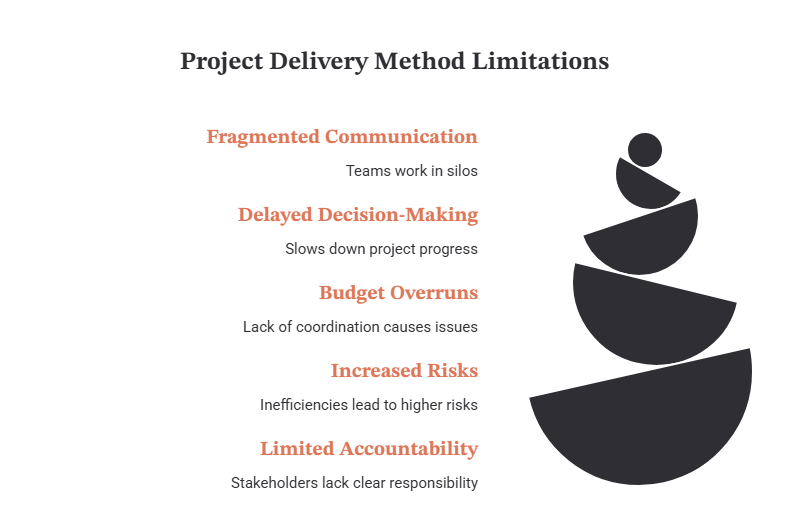
These issues often lead to compromised project quality and reduced returns on investment.
Key Principles of Integrated Project Delivery
Integrated project delivery is built on a set of core principles that drive collaboration, improve efficiency, and ensure better project outcomes. These principles not only align stakeholders but also create a structured framework for seamless execution.
Early Involvement of Stakeholders
To begin with, one of the most important aspects of integrated project delivery is the early involvement of all key stakeholders. Developers, consultants, designers, and contractors actively participate from the initial planning stage itself.
As a result, teams achieve better alignment, reduce uncertainties, and minimise the chances of unexpected challenges during later phases of the project.
Shared Risk and Reward
In addition, integrated project delivery promotes a shared risk and reward model. All stakeholders work towards common objectives and collectively take responsibility for project outcomes.
This approach not only strengthens accountability but also encourages proactive problem-solving and stronger commitment across teams.
Transparent Communication
Moreover, transparent communication plays a critical role in ensuring project success. Teams maintain open, consistent, and real-time communication throughout the project lifecycle.
Because of this, they can identify potential issues early, address them quickly, and avoid delays or misunderstandings that typically arise in traditional project models.
Data-Driven Decision Making
Finally, integrated project delivery relies heavily on data-driven decision making. Teams use real-time data, analytics, and insights to guide their actions and strategies.
How Integrated Project Delivery Improves Business Outcomes?
The true value of integrated project delivery lies in its ability to drive better business results.
Improved Cost Efficiency
By aligning all stakeholders and planning collaboratively, unnecessary expenses are reduced. Cost estimation becomes more accurate, and financial risks are minimised.
Faster Project Completion
With streamlined workflows and better coordination, projects move faster from planning to execution. This helps businesses achieve quicker returns on investment.
Enhanced Quality of Development
Continuous collaboration ensures that design, execution, and quality standards are aligned, resulting in better-built assets.
Reduced Project Risks
Early identification of challenges allows teams to implement preventive measures, reducing the likelihood of disruptions.
Better Resource Utilisation
Integrated planning ensures optimal use of manpower, materials, and technology, leading to increased efficiency.
Stronger Stakeholder Relationships
When all parties work together with shared goals, trust and collaboration improve, leading to smoother project execution and long-term partnerships.
Role of Real Estate Project Consultants in IPD
Implementing integrated project delivery requires expertise, coordination, and strategic planning. This is where real estate project consultants play a critical role.
They help in:
- Structuring the integrated delivery model
- Aligning stakeholders and defining responsibilities
- Managing communication and coordination
- Monitoring performance and progress
- Ensuring cost, quality, and timeline control
Their involvement ensures that the integrated approach delivers tangible business outcomes.
How AISP Implements Integrated Project Delivery?
AISP adopts a structured and practical approach to integrated project delivery, ensuring that projects are aligned with business objectives from the start.
Holistic Project Planning
AISP integrates feasibility analysis, design planning, and execution strategy into a single framework, ensuring clarity and alignment.
Centralised Coordination
By acting as a single point of control, AISP ensures seamless communication across all stakeholders, reducing delays and errors.
Proactive Risk Management
AISP identifies potential risks early and implements strategies to mitigate them, ensuring smoother execution.
Technology-Driven Approach
Using data and modern tools, AISP enhances decision-making and project monitoring, improving overall efficiency.
Focus on Business Outcomes
Beyond project completion, AISP prioritises ROI, asset value, and long-term sustainability, ensuring that projects deliver real business impact.
Final Thought
Integrated project delivery is transforming the way commercial real estate projects are planned and executed. By breaking down silos and encouraging collaboration, it creates a more efficient and outcome-driven process.
For businesses, this means better cost control, faster execution, improved quality, and higher returns.
With the support of experienced real estate project consultants like AISP, integrated project delivery becomes a powerful strategy to achieve long-term success in complex real estate developments.
FAQs
What is integrated project delivery in real estate?
It is a collaborative approach where all stakeholders work together from the early stages to improve efficiency and outcomes.
How does it improve ROI?
It reduces costs, speeds up timelines, and enhances quality, leading to better financial returns.
Why is collaboration important in project delivery?
Collaboration ensures better communication, faster decision-making, and fewer errors during execution.
How do real estate project consultants support IPD?
They manage planning, coordination, communication, and execution to ensure the success of the integrated model.
How does AISP implement integrated project delivery?
AISP uses a structured, technology-driven, and collaborative approach to ensure efficient planning, execution, and business-focused outcomes.